There are several groups calling for a general strike on May 1st. The hope is that a massive disruption of the economy will continue to build opposition to Trump, possibly force him to stop the war in Iran, and maybe even force him step aside. For my part, I very much doubt that the kind of protests being organized will result in mobilizing the 10 million plus people necessary for a successful general strike. The ones being organized in Houston appear to be diffuse and likely only to engage a few hundred people.
Nonetheless, labor actions still have the possibility to be disruptive and mobilize opposition to the President, his cruelty, and his authoritarian aspirations. The victories that the Iranian government has managed to win in the current war between the United States/Israel and Iran offer a good example of how. That conflict is an instance of asymmetric warfare. The military power between the forces are completely misaligned. With an annual war budget of almost $1.1 trillion, the United States is the world’s largest military. Iran, by contrast, only spends $7.3 billion. Yet, as Paul Krugman recently pointed out, and many others have noted, the Iranian regime has humiliated the United States by effectively taking control of the Strait of Hormuz.
Amongst those of us opposed to the President’s politics of cruelty and struggling to build a more democratic society, the Iranian success should be a reminder that strategies beyond mass mobilization are available. The call for May Day general strike, in particular, has me thinking of the “Pinchpoint Target” and “Choke Points.” In a column for Workers Power, which I used to edit, Nate Hawthorne defines the Pinchpoint Target as “the idea that there’s one key sector or a few key sectors of the economy where organized workers could shut down capitalism.” Labor Historian John Womack Jr described what made such sectors so vulnerable to worker organizing by using the notion of the Choke Point. His understanding of Choke Points has been summarized by Peter Cole, another labor historian, as “taking advantage of strategic vulnerabilities in supply chains and individual workplaces.”
The backup in global shipping at the Strait of Hormuz is a reminder of just how effective such strategies can be. The damage being caused to the global economy is incredible and could well trigger a global recession. With this in mind, opponents to the President in the US could attempt a similarly disruptive effort by leveraging the choke points around shipping. Like the rest of the world, the US economy largely runs on just-in-time shipping and even slight delays in the delivery of goods can have huge economic impacts.
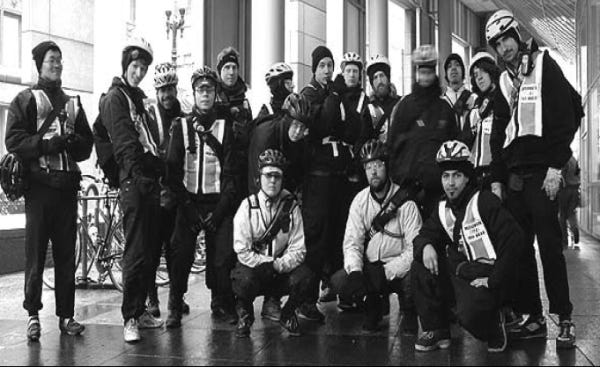
I know a bit about the leverage that comes from exploiting the just-in-time nature of the US economy first hand from my experiences organizing bicycle couriers in Chicago almost twenty years ago. Back then, we were able to exploit the need for packages to be delivered quickly to disrupt business and win workplace gains by staging brief strikes that last only a few hours. These job actions were enough to force concessions from employers. They undermined their ability to promise timely deliveries that met their client needs.
A little later I was involved in an effort to organize troqueros* in the Ports of Los Angeles/Long Beach. While that effort ultimately came to naught, it did involve a dramatic strike that essentially shut the ports down for a day. That happened not by successfully mobilizing the majority of the workforce. Instead, it came from shutting down the highways that led into and out of the ports by blocking them with a handful of trucks.
In future mass mobilizations opponents of the President could use a similar strategy. Rather than attempting to bring millions of people out to protest, they could instead concentrate efforts on choke points that would bring the US economy to a standstill. The nation’s ports could be disrupted by coordinated civil disobedience efforts involving only a few thousand people. This is something that a small organization, with a national reach, like the Democratic Socialists of America or the Industrial Workers of the World, could coordinate.
All of the nation’s ports have only a few entrances and exits that can be easily blocked. The highways leading into and out of them can be effectively closed by a few vehicles. What is more, the International Longshore and Warehouse Union (ILWU) has clauses in its master contract that might be exploited to encourage them to participate in such actions. ILWU members could possibly plead that such an action represents a matter of “health and safety” and refuse to work until it is resolved. They have done so in the past.
It is increasingly accepted that the United States is sliding into authoritarianism. Democracy is not something that exists primarily in legislatures or in capitals. It is created by people coming together to decide how they want to live their lives and organize their society. As Iran’s control of the Strait of Hormuz should remind us, acts of democratic practice can include the creative use of pinchpoint targets and choke points in opposition to rising authoritarianism.
*Troqueros are non-unionized short haul port truck drivers who usually move cargo from ships to trains since the two modes of transit are rarely directly connected.

