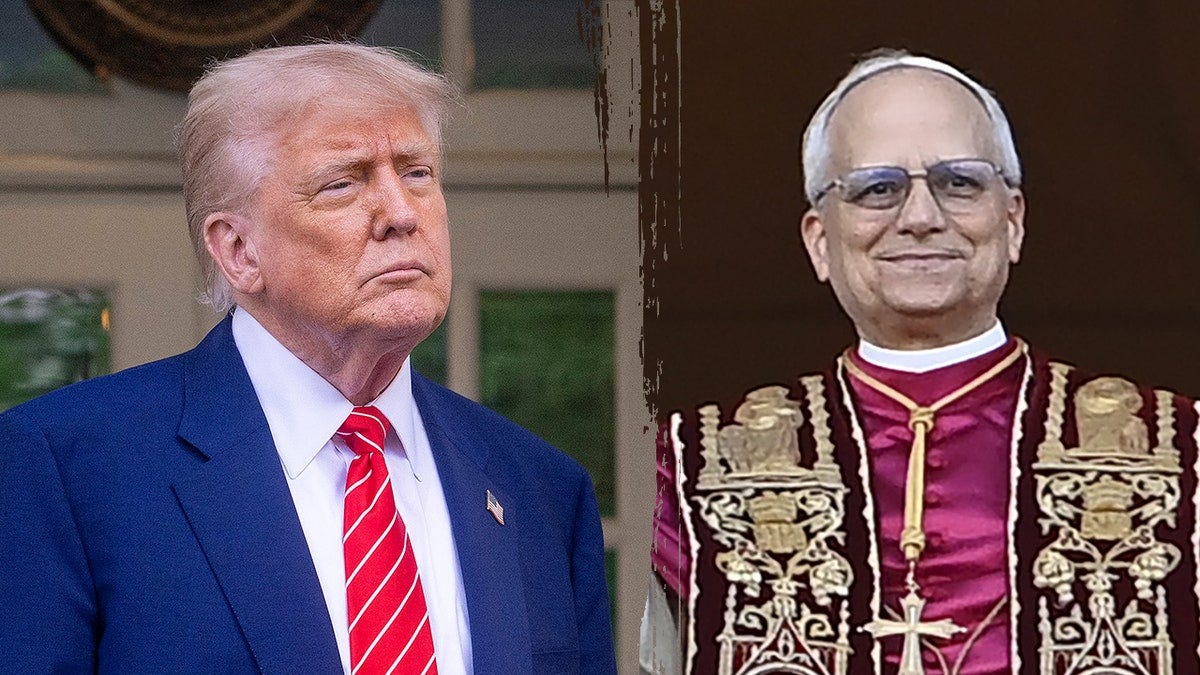
The feud between President Trump and Pope Leo XIV has been the subject of a fair amount of commentary. Some of the President’s allies have warned the Pope not to talk about theology or claimed that he doesn’t understand the Bible. Critics of the President have found Pope Leo to be inspiring. Some lapsed Catholics even appear to be reconsidering their relationship to the Catholic Church based on Pope Leo’s bravery.
What I have yet to see is an analysis that puts the President’s complaints about the Pope within the context of a larger political tradition. In my forthcoming book The Political Theologies of Populism, I argue that the President and his followers are the latest incarnation of a white supremacist populist tradition that begins with President Andrew Jackson. It runs through the Confederacy, the first and second Ku Klux Klan, the Dixiecrats, Nixon’s Southern Strategy, and has culminated most recently in the President’s first and second terms. It is notable for trying to enshrine White male sovereignty into law and consigning everyone else to second class citizenry or removing them from citizenship altogether. It is also a distinctly Protestant tradition. For most of its existence it was specifically anti-Catholic. That stance has moderated in recent years, in part because a large number of second, third, and fourth generation Catholics have at least partially integrated into Protestant culture: treating religious affiliation as a matter of choice, flattening the theological distinction between Catholicism and Protestantism, and reading the Bible for themselves (rather than having it interpreted for them by the Church).
Still, when I heard the President and his allies criticizing the Pope I could not help but recall the words of earlier generations of white supremacist populists, particularly the Ku Klux Klan of the 1920s. Klan leaders demanded that the United States be conceived of as an explicitly Christian nation. “I believe in God and in the tenets of the Christian religion and that a godless nation can not long prosper,” began “A Klansman’s Creed.” At the same time, they asserted, “I hold no allegiance to any foreign government, emperor, king, pope or any other foreign, political or religious power.” The message was simple, Klan leaders, many of whom were Protestant clergy, were to adhere to a form a Christianity that imagined the Pope as an interfering figure who undermined their religious sovereignty, the project of building a religious nation, and represented a threat to democracy. Klan pamphlets denounced the head of the Catholic Church with warnings like, “The Pope has become a King.” At the same time, Klan leaders asserted that Catholics themselves would be fine so long they behaved like Protestants and organized “themselves into churches, and fraternal and political groups” which did not explicitly look to the Catholic hierarchy for doctrinal or ecclesiastical authority.
I detect a similar dynamic at work today. Individual Catholics are welcome to advise and support the President (or even become Vice President) so long as they support presidential over papal authority. Their votes are courted along the many of the same culture war lines of those of evangelical Christians. The Pope might even be celebrated as the first American Pope. But as soon as he offers a theological vision that is critical of the President’s policies–especially his war on Iran–then the Pope, even an American Pope, is recast by white supremacist populists as a foreign figure: he is depicted as an individual who knows little of theology, and less about politics. This points to significant questions: How consequential will the rhetoric of the President and his followers be for the fragmentation of their coalition? When pushed to choose, will Catholic supporters of the President pick him–and implicitly the white supremacist populist tradition which he represents–or will they side with papal authority and the enduring tradition that it represents? The answers to such queries will likely unfold not in the coming weeks but in the coming years.

