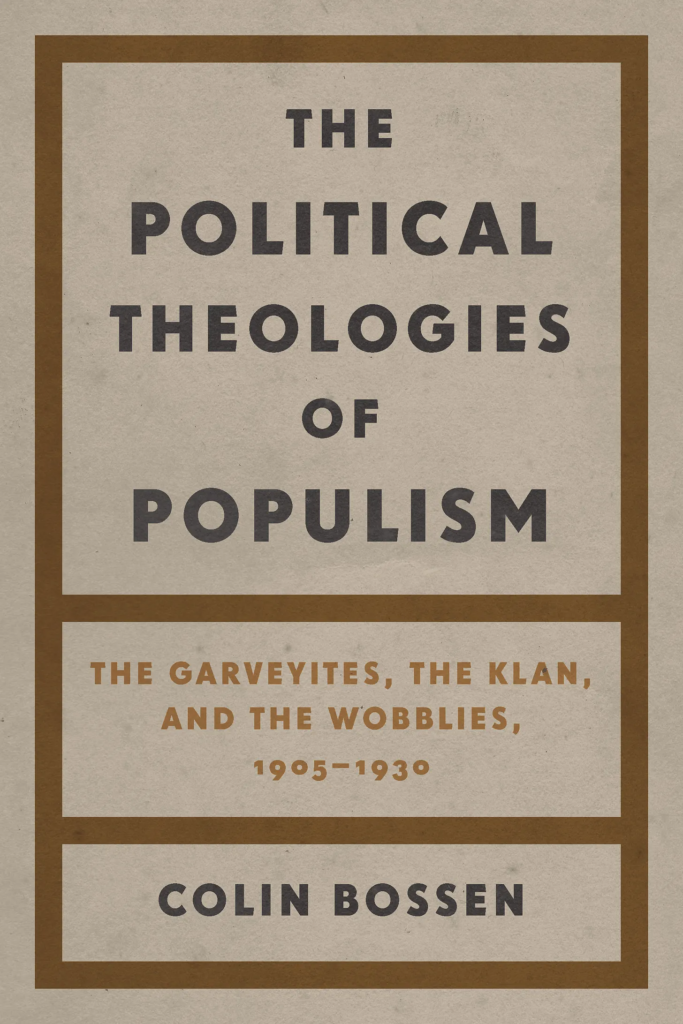
My first monograph, The Political Theologies of Populism: the Klan, the Garveyites, and the Wobblies, 1905-1930 (Wayne State University Press), was recently published. It argues that for over a century, American populist movements—even explicitly secular ones—have drawn on religious ideas and practices to infuse their politics and bring people together. In it I explore how Pan-African populism, white supremacist populism, and early twentieth-century pluralistic populism in the United States coalesced into well-known, vastly different groups with a lasting presence in the American imagination: the Universal Negro Improvement Association (also known as the Garveyites), the Ku Klux Klan, and the Industrial Workers of the World (also known as the Wobblies). The Afterword contains reflections on how Unitarian Universalists might relate to today’s populist movements. It can be ordered through the publisher and many online bookshops.
American Populism and Unitarian Universalism (Palgrave Macmillan) comes from my 2019 Minns lectures of the same title. It traces the arc of white supremacist populism in the United States from Indian Removal under Andrew Jackson through the administration of Donald Trump in an effort to answer the question: How should Unitarian Universalists respond to populism? The book points out the inefficacies that progressives, with their focus on state centered reform, use as a means of combating white supremacist populism. And argues that religious liberals, particularly Unitarian Universalists, can more effectively engage in the struggle against white supremacist populism by turning away from progressivism and turning towards the prefigurative traditions of anarchism and antifascism. It should be out sometime in August.
I am in the copyediting phase of Contemporary Unitarian Universalist Theologies: A Global Study (Brill). It is part of the series Research Perspectives in Theology and will offer the first global survey of the contemporary movement’s theology. In it I argue that the tradition is best understood as a hybrid faith, which has often emerged at the edges between different religious communities. I also explore the major theological tendencies within this pluralistic tradition and posit that the dividing line is not between theists and humanists, as has often been claimed, but between foundationalists and anti-foundationalists. In addition, I note the particular emphasis in current Unitarian Universalist theology on recentering voices from the tradition who have been historically marginalized. I make my own contribution to this effort through a recovery of the Unitarianism of the Rev. Robert Wedderburn, the first Black Unitarian minister.