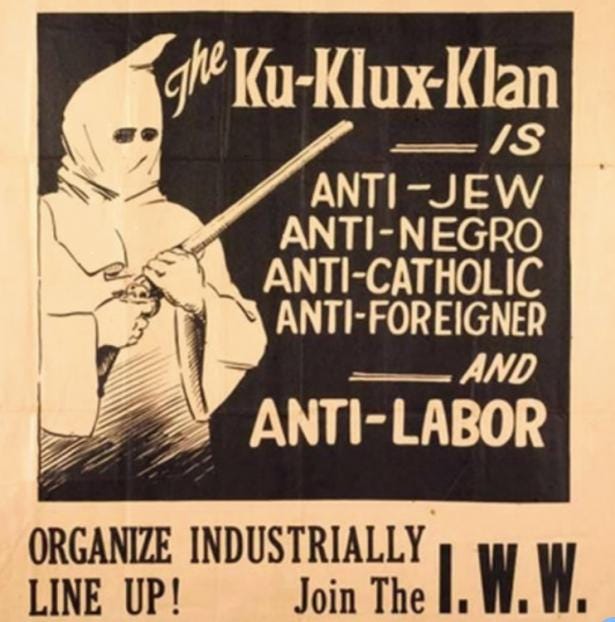
In The Political Theologies of Populism: the Garveyites, the Klan, and the Wobblies, 1905-1930 I trace the histories and political theologies of three different types of populism in the United States: white supremacist, Pan-African, and pluralistic populism. Unfortunately, it is the white supremacist variety that is ascendant today.
I argue that for white supremacist populists, White people become the people. The mission of white supremacist populists is, in W. E. B. Du Bois’s words, to proclaim “that whiteness is the ownership of the earth forever and ever, Amen!” This social vision is expressed in a popular ditty of the Jacksonian era. Written approximately forty years before the US Civil War, it runs: “All I want in this creation / Is a pretty little wife and a big plantation / Away up yonder in the Cherokee nation.”
The verse offers insight into the political theology of Jacksonian white supremacist populists. The speaker is male and believes himself to be White. He aspires to be a wealthy slave master–to own “a big plantation”–and to dispossess the Cherokee of their land. Implicitly, he believes land, women, and people of color belong to him or can be disposed of by him. He seeks to be sovereign of “this creation.” As the lyric attests, white supremacist populists used genocide to create a White populus—a nation of White males who ruled over enslaved Africans, expelled Indigenous nations from their ancestral lands, and treated White women as anything but equals.
The origin of this tradition arguably lies with the presidency of Andrew Jackson, though white supremacy itself is constitutive of the United States, most forms of European nationalism, and the various settler colonialist states. What makes Jackson’s presidency the consolidating point for white supremacist populism is that unlike his predecessors he believed in the expulsion of people he did not think of as White as necessary to the expansion of White male citizenry. Earlier presidents were generally more ambiguous on this point, believing that Indigenous populations would either die out or be assimilated into Whiteness. Jackson, in contrast, sought to extend a White empire across the North American continent and exclude everyone who was not either a descendant of Europeans or a European immigrant from his conception of the people. This marks him as distinctive from his immediate predecessor, John Quincy Adams, who thought that Indigenous populations could be incorporated into the citizenry of the United States as long as they acted White.
As a tradition white supremacist populism runs from the 1820s to the Confederacy, the Ku Klux Klan of the 1870s, the second Ku Klux Klan of the 1920s, the Dixiecrats of the 1950s, 60s, and 70s, and provides connective tissue between Jackson’s presidency and the current President. Early in his first term, Trump lifted up Jackson as an example of the kind of president he hoped to be: concentrating power in the executive, empowering White males at the expense of all others, and casting his opponents as existential threats to the survival of the United States. An example of the similarities between Trump and the second Klan can be seen in his first inaugural speech, which I detailed in a piece for the Huffington Post almost a decade ago.
In my book I trace the history of white supremacist populism from Jackson to Trump with an emphasis on the Ku Klux Klan of the 1920s, which I argue, had a similar political theology to the current president’s rhetoric. In the next couple of weeks I share brief descriptions of Pan-African and pluralistic populism and along with why I think that they can provide powerful counters to the white supremacist variety of populism.

